The Spy Inside the Box: How Tampered Ledger Wallets Leaked Seed Phrases Over LTE
By Elias Lankinen15 min read
Three seconds, thirty wallets
At 04:59:57 UTC on October 9, 2026, thirty wallets on the TRON blockchain got a new owner within three seconds. A fresh controlling key was written into each account's permissions, and each paid the network's 100 TRX fee for the change. Soon after, 25 of them signed the same token approval within three seconds of each other. In the six seconds that followed, about $29 million in USDT stablecoins drained out. At 05:54:20, 111 Bitcoin wallets were emptied in a single block. Those timestamps come from a running investigation by the blockchain analytics firm Bitquery. By October 16 it counted roughly $102 million taken from 335 wallets across six chains. Tether froze about $10 million of it. Much of the rest went through Tornado Cash and cross-chain swaps. None of the victims had clicked a phishing link or pasted a recovery phrase into a fake website. Most had done what security guides tell you to do and bought a hardware wallet. The leak had happened weeks or months earlier, at the moment such a device asks for complete trust: when it first shows 24 words and tells its owner to write them down. A second circuit board hidden behind the screen read those words off the display wiring. It then sent them out over the mobile phone network, using an LTE modem and an embedded SIM card the owners never knew they had.
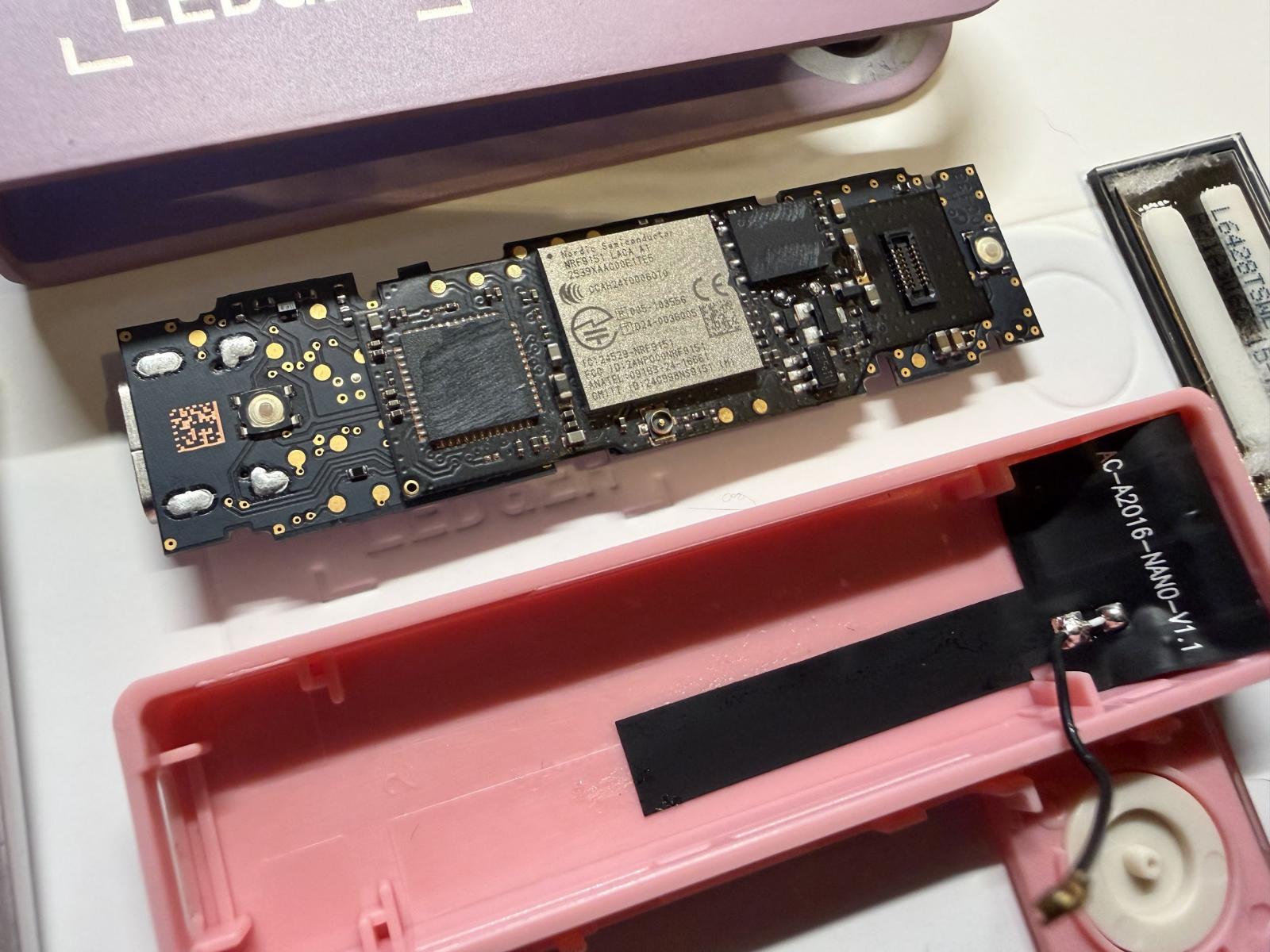
The headline loss figure is still disputed. Early on-chain estimates ran from $86 million to $93 million. Ledger, the Paris-based company that makes the devices, told The Block that "figures circulating online come from third parties and Ledger has not fully verified them." The mechanism is not in dispute. On October 10, Ledger confirmed that "one of the impacted users' devices contained an unauthorized hardware implant." Three days later its in-house security lab, Ledger Donjon, explained how the implant worked.
The one moment a hardware wallet cannot protect
A hardware wallet (Ledger now calls them "signers") exists to keep the keys that control cryptocurrency away from internet-connected computers. All of those keys come from a recovery phrase, also called a seed phrase. Under the BIP-39 standard, a 24-word phrase encodes 256 bits of randomness plus an 8-bit checksum, and every word comes from a fixed list of 2,048. Anyone who has those 24 words can rebuild every key on any device, anywhere. Nobody needs to steal the device. Ledger protects the keys with a secure element, a tamper-resistant chip of the kind used in payment cards, built to withstand probing and fault-injection attacks. The Nano X, the model at the center of this story, pairs that chip with an ordinary STM32 microcontroller that handles USB and Bluetooth. Ledger's 2019 description of the Nano X security model spells out who does what: "The Secure Element is in charge of getting user inputs and driving the screen where critical information is displayed," while the microcontroller "simply acts as a proxy." The idea was that malware on the less trusted chip could never fake what the screen shows. That design protects integrity: it keeps the screen from lying to you. It does not protect confidentiality. During setup the recovery phrase has to leave the secure element as pixel data, run along copper traces to the display, and light up in front of a person. Nothing on that short stretch of wire is encrypted. Analysts have pointed out that the display is the exposed moment for exactly this reason. The secure element's guarantees stop at its own pins. Ledger's authenticity test, the Genuine Check, stops at the same place. The secure element holds a key installed at the factory, and it proves its identity by signing a challenge sent by Ledger's servers. Ledger's published threat model says plainly that "a Genuine check cannot detect unauthorized physical modifications to the hardware" as long as the original secure element is intact, and it gives spying implants as the example. A Ledger Academy buying guide, last updated on September 18, carried the same warning three weeks before the theft.
Inside the implant
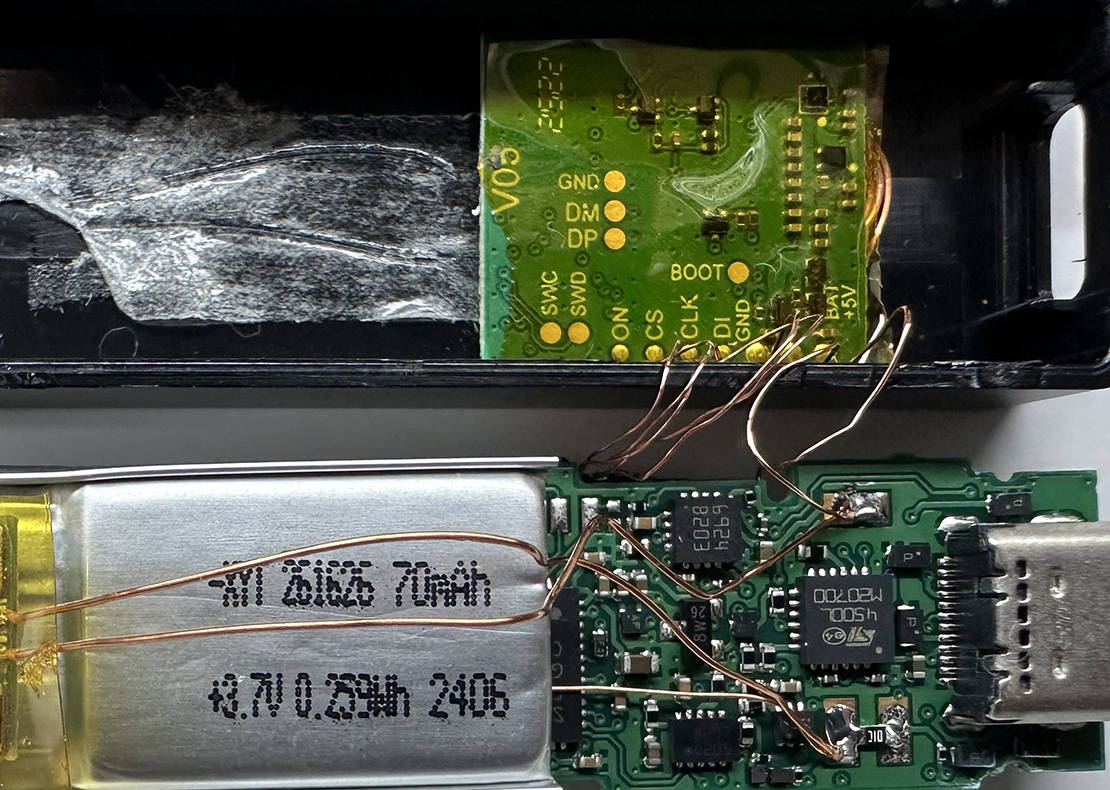
The first public specimen appeared in August 2025. A Reddit user posted photos of a secondhand Nano X, bought in Thailand, with something extra inside. Hardware hacker Joe Grand took it apart, according to Kim Zetter's reporting at Zero Day. He then bought eight more Nano X units from Thai sellers on the Lazada marketplace, and four of those were compromised too. That first implant is crude next to what came later: a small green board marked V05, glued inside the case and wired in with thin enamelled copper. The pad labels in Grand's photo show what it was for. Three of them read CS, CLK and DI, short for chip select, clock and data in. Those are the lines of an SPI (Serial Peripheral Interface) bus, the simple serial link that carries pixel data to a small display. The implant never talks to the secure element. It only listens to what the secure element sends to the screen.
Reading words off a wire
Turning that captured pixel stream back into text is easier than it sounds. The wallet draws every letter from a fixed font, so each character is the same bit pattern every time and a cheap microcontroller can recognise it. BIP-39 makes the job even easier. Its word list was designed so that "it's enough to type the first four letters to unambiguously identify the word," and its checksum lets anyone check that a captured phrase is valid before trying it. Donjon put it simply: "When the implant detects these screens, its microcontroller decodes the words and transmits them over LTE using a provisioned eSIM." Mark Karpelès, who later took apart several units, told BleepingComputer that the implant also recorded button presses. That has a consequence people tend to miss: restoring an existing phrase onto a bugged device leaks it as well, because each word appears on screen as you type it in. Hence Ledger's blunt instruction: "Do not enter or restore any recovery phrase on a signer bought from CryptoBilis."
Why a cellular radio
Using LTE was the clever choice. A Nano X already has Bluetooth, but abusing it would require a paired phone nearby, and Wi-Fi would require a password. A cellular modem only needs a phone mast in range. The SIM is an eSIM, or embedded SIM: the chip that identifies a subscriber to a mobile network, made small enough to solder onto a board, with the carrier profile loaded electronically. Grand's unit had a data-only profile and a hand-wound coil antenna. Later units examined by Karpelès's firm, Tibane Labs, used an STM32G431 microcontroller and an eSIM in an eight-pad package just 2 by 2 millimetres, along with a shielded LTE module. In the photo of his at the top of this article, that module carries the marking of Nordic Semiconductor's nRF9151. This is an off-the-shelf 12 by 11 mm part for LTE-M and NB-IoT, the low-power cellular standards used by smart meters and asset trackers. There is very little to send: 24 words at 11 bits each is 264 bits, or 33 bytes, about a quarter of one SMS.
From hand-soldered prototype to production run
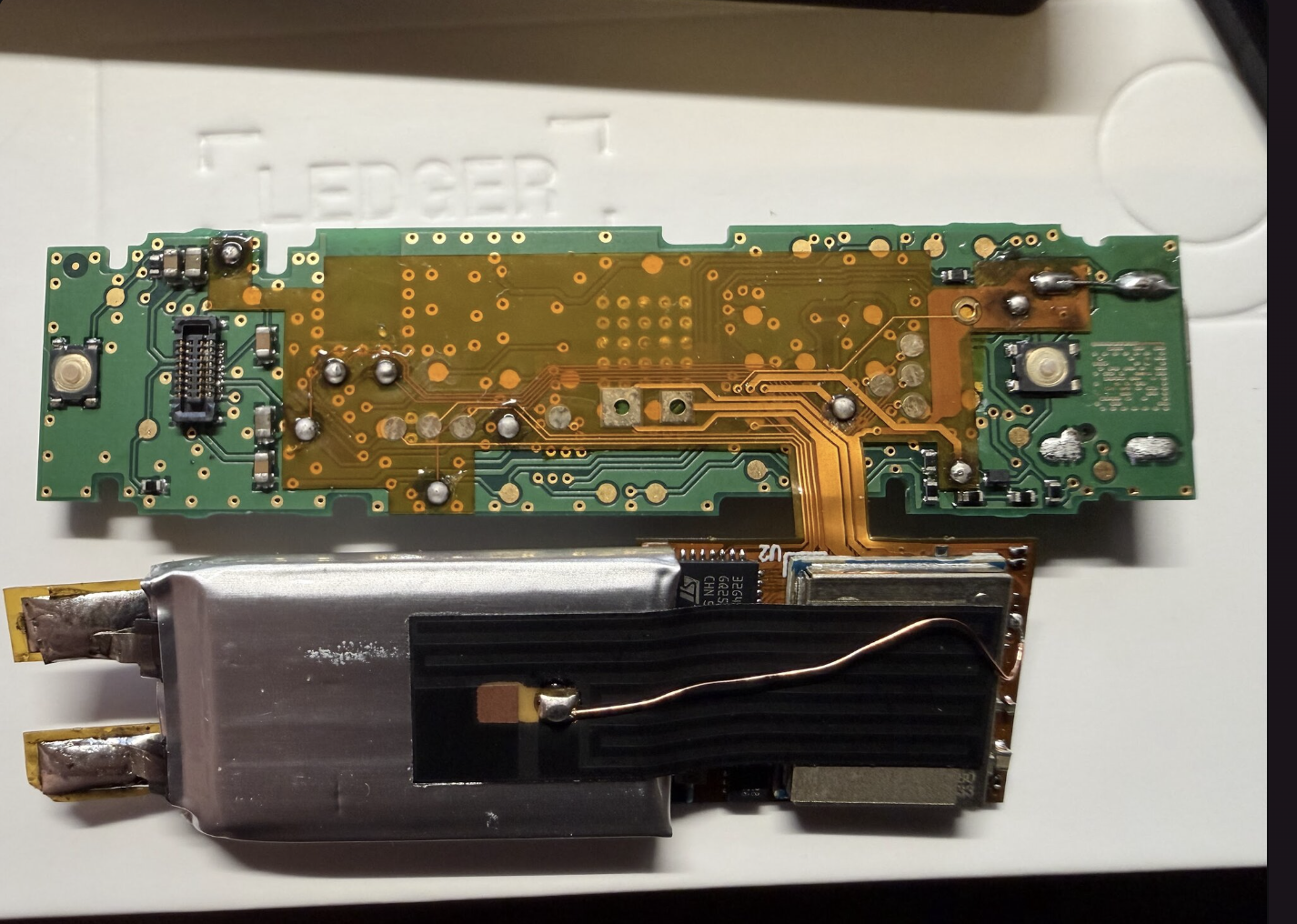
Grand reported his findings to Ledger on March 4, 2026. Ledger confirmed them and said it was "investigating internally," according to PANews. He presented the teardown in public at Tropicon in April and at Hardwear.io USA in Santa Clara in late May. His abstract there said hardware implants "are often discussed, but rarely seen in the wild." By then there were plenty of them in the wild. Karpelès, the former head of the collapsed Mt. Gox exchange, bought two Nano X units in September after reading Grand's work. One came at half price from an Amazon seller and was shipped from Malaysia. His teardowns show the design improving from one generation to the next. In the second generation, Grand's loose wires gave way to a custom orange flexible circuit laminated onto the genuine board, plus a smaller battery, and component markings pointed to assembly in December 2025 or later. The third generation was coated black to blend in with the board underneath, its chip markings were scraped off, and its antenna was silk-screened with a part number, AC-A2016-NANO-V1.1. "'NANO' names the target," Karpelès wrote. "That is a production run, not a one-off." A Japanese researcher who spoke to Zero Day without being named went further. He bought ten Nano X units from unauthorized sellers, mostly on Amazon Japan, and every one of them had an implant, across five different designs. An eSIM remembers the last cell tower it connected to, so the hardware itself gave clues about where it had been built and tested. From the firmware he traced the transmissions to servers in an Alibaba-managed data center in Hong Kong, and he believes at least 90 implants were reporting seeds to them in June. Around July or August, he said, several sellers dropped the Nano X and switched to the larger Ledger Flex, for which a new implant seems to have been built. Ledger has not confirmed any of this. The blockchain record shows the same patience. Bitquery found that more than eight in ten drained wallets first received funds in June 2026 or later. About six in ten fell inside the 90-day purchase window Ledger first warned about. The attackers prepared for weeks. A withdrawal from the Bybit exchange on September 24 funded a control address, and between September 26 and October 7 they ran 21 test transactions on TRON and 20 on Ethereum. Then they waited while victims deposited money. One wallet first funded on September 15 lost 7,001,000 USDT on the morning of the raid. Another received 80 BTC on September 29 and lost all of it in the 05:54 block. Collecting seeds and sitting on them is rational. Draining any single wallet early would have set off alarms and ruined the rest. Why the attack came when it did is less clear. Zero Day reports that Karpelès started posting his findings on X on October 8, and the theft began the next morning. Nobody outside the group knows whether the attackers moved because their hardware was about to become famous.
"Localized" or systemic?
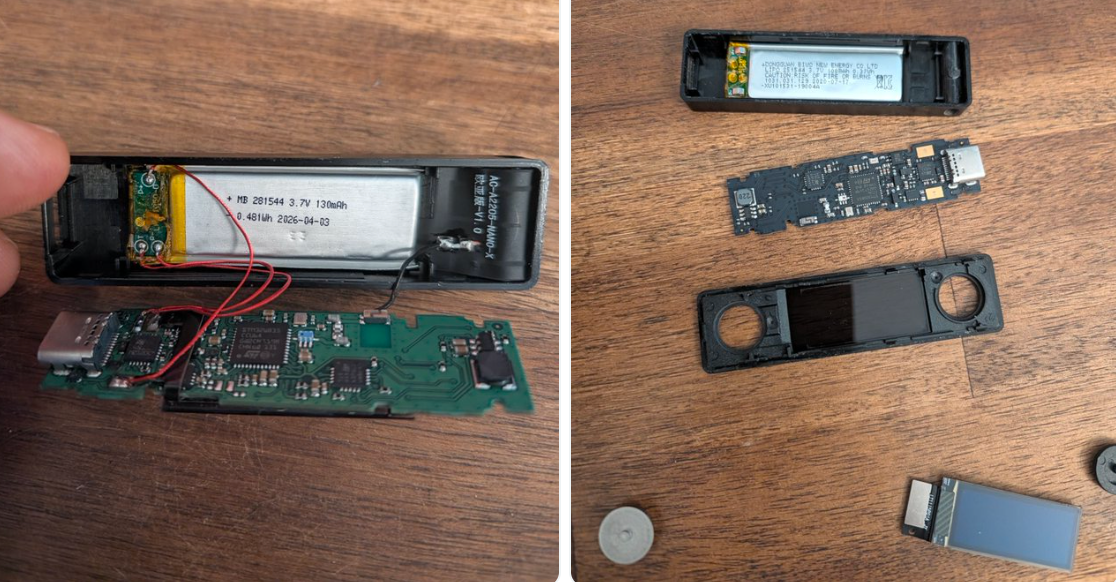
Ledger's official account, published October 15, describes a "highly organized criminal group." According to Ledger, the group bought genuine devices over many months, opened them, fitted hidden parts, and fed them back into distribution through resellers in Southeast Asia, while running its own servers for collecting seeds and draining wallets. As heise online quoted it, "they were patient, they spent millions, and they struck in one coordinated operation." Ledger's verdict: "This was not a systemic supply chain attack, it was a localized distribution attack." That distinction is real. Ledger's factory, firmware and servers were not compromised, and every bugged device had a genuine Ledger secure element inside. Ledger says every confirmed theft traces back to CryptoBilis, a Malaysian reseller authorized to sell Ledger devices in Malaysia, Indonesia and the Philippines. It also says its own test purchases, including some in Germany, and samples from its warehouses all came back clean. What outsiders have found does not fit "localized" very well. Specimens have turned up via Amazon Japan, Yahoo! Auctions Japan and Lazada in Thailand. Heise reported two Singapore buyers who found implants in a Ledger Flex. One of them bought it from an airport vending machine operated by an official Ledger reseller. In Germany, a buyer posting as Johannes found implants in a Nano X bought at a MediaMarkt store in August, and in a second unit bought at another branch on October 12. According to heise, both came from an Austrian distributor, not CryptoBilis. MediaMarkt Saturn took Ledger products off sale on October 13. Ledger says no funds were lost in the German case and has not linked it to CryptoBilis. CryptoBilis has an odd history of its own. Co-founder Arravind Prabu told Zero Day that the company was sold in March under a non-disclosure agreement that lasted until mid-October, and that both founders stepped down. He did not name the buyer. Zero Day stresses that nothing so far shows CryptoBilis staff were involved. The company has stopped all hardware wallet sales and closed its shops. There is also the question of what Ledger knew, and when. Karpelès says at least two people reported tampered devices to Ledger as early as December 2025, and Grand's report is dated March 4. Ledger has declined to say how it handled Grand's report. Heise also pointed out that Ledger's marketing still said "hackers cannot access your keys via the internet because they are stored offline." The countermeasures so far are procedural. Returned devices may never be resold. Ledger devices are no longer to be put on shelves, where a bugged one could be swapped in, and staff hand them over from the stockroom at purchase. Resellers in Southeast Asia and Hong Kong were asked to stop selling. Competitors reacted too. Trezor is cutting back its authorized sellers, and the ones it drops lose their status on January 1, 2027. Its chief commercial officer, Danny Sanders, still says "there is not a single piece of evidence that Trezor devices have been compromised." OneKey offered free replacements for any device bought from CryptoBilis since March 1.
Five comfortable beliefs that did not survive
"The secure element was hacked." It was not, and that is the worrying part. Donjon says the implant "does not modify the Secure Element or the Ledger operating system, and it does not alter transactions or signatures." The chip did everything it was built to do. The attack simply went around it. "Passing the Genuine Check means the device is clean." All it means is that the secure element is genuine. Ledger's own documentation says the check cannot see added hardware, and Karpelès's unit passed it. "It was still shrink-wrapped." Karpelès told Help Net Security that his device arrived in intact shrink wrap. Ledger's threat model has said for a long time that "classic anti-tampering seals (or holographic seals) can give a false sense of security" because they are "trivial to clone." The only reliable test Karpelès found was to open the case. "Offline means unhackable." The wallet was offline. The implant was not. "Air-gapped" describes the connections a device was designed to have, not every part someone can add to it later. "Authorized resellers are safe." Buying through authorized channels lowers the risk, and Ledger still recommends it. But CryptoBilis and MediaMarkt were both authorized. Ledger's buying guide admits the Genuine Check "cannot verify the device's physical supply chain history."
An old espionage trick, made cheap
Hardware implants used to be tools for spy agencies. The NSA's ANT catalog, a product list from 2008 to 2009 that Der Spiegel published in December 2013, offered COTTONMOUTH-I. It was a doctored USB plug with a hidden radio, sold at about $20,300 per unit, and its spec sheet promised "air-gap bridging." In 2018 a 15-year-old named Saleem Rashid showed that the secondary chip in Ledger's Nano S could be reprogrammed to tamper with the seeds it generated, and Ledger fixed this in firmware 1.4.1. In 2021, after the personal details of 272,853 Ledger buyers leaked online, criminals mailed out fake "replacement" Nano X devices with a flash drive soldered inside, hoping victims would type their seeds into a counterfeit app. The 2021 scam only worked if the victim was fooled. The 2026 implant only needed the victim to use the product exactly as the instructions say. What changed is cellular IoT hardware. A radio module, a microcontroller and an eSIM small enough to fit into a wallet's foam padding, plus a data plan, are now within reach of criminals, not just governments. Ledger says the attackers spent "millions." Set against a haul that third parties put at around $100 million, that is an easy business case.
What a real fix would have to change
Shelf rules and resale bans make it harder for this particular group to get devices to buyers. They do not change the basic fact: a genuine device can be opened, bugged and resealed, and its own self-test will not notice. Ledger says it is working on further measures at the product level and has told customers to "stay tuned," with no details. Every engineering option has a cost. Encrypting or authenticating the link between the secure element and the display would turn a wiretap into noise, but the display hardware would then need to decrypt, which ordinary panel driver chips are not designed to do. Tamper-sensing cases, which card payment terminals already use, could permanently record that a device had been opened and make the Genuine Check fail, at the price of more expensive and less repairable devices. Some wallet designs never display a seed at all, which swaps this risk for different problems with backup and recovery. Users already have one structural defence: a multisignature setup spread across devices from different makers, so that no single bugged box can give everything away. For CryptoBilis buyers, Ledger's advice is concrete. If the device has not been set up, do not set it up. If it is already in use, move the funds to a new signer with a new recovery phrase and never enter the old phrase anywhere again. Anyone who has lost funds should "coordinate with law enforcement before opening the signer," so that evidence is preserved. The biggest unknown is how many captured seeds the group still has. A seed that has been captured stays compromised for good, whatever device it is later restored onto. The Japanese researcher's figure of at least 90 implants reporting in June was counted before the Flex generation and before the German and Singapore finds. Ledger has promised a fuller technical disclosure, Japanese police have been briefed, and the buyer of CryptoBilis is still unnamed. The wallets worth watching now are the ones that have not been drained yet. For a decade the industry's core advice was "trust the screen." This attack never changed a pixel of what the screen showed. It only had to read it.
Sources
- Bitquery, Ledger CryptoBilis Hack: on-chain investigation, 2026
- BleepingComputer, Ledger confirms spy chip implant behind wallet crypto thefts, 2026
- The Block, Ledger confirms hardware implant in CryptoBilis reseller units as MediaMarkt suspends sales in Europe, 2026
- Ledger on X, Update from Ledger Donjon on the CryptoBilis investigation, 2026
- Bitcoin BIPs, BIP-39: Mnemonic code for generating deterministic keys, 2013
- Ledger, Ledger Nano X and Bluetooth: Security Model of a Wireless Hardware Wallet, 2019
- Ryder, Ledger Implant: What the Spy Module Research Shows, and What It Doesn't Prove, 2026
- Ledger Donjon, Threat Model: Device Genuineness, 2026
- Ledger Academy, Best Practices To Securely Buy Your Ledger Signer, 2026
- Zero Day (Kim Zetter), Who Is Planting Backdoors in Ledger Crypto Wallets?, 2026
- Grand Idea Studio (Joe Grand), Ledger Hardware Implant, 2026
- The Record, Ledger says hardware implant in cryptocurrency wallets stole recovery phrases, 2026
- Nordic Semiconductor, nRF9151 product page, 2026
- PANews, Researcher says Ledger received hardware implant reports months ago, 2026
- Hardwear.io, Reverse Engineering a Ledger Nano X Hardware Implant, 2026
- Ledger, Ledger's Response to the Hardware Implant Attack, 2026
- heise online, Bugged wallets: Ledger calls it an "attack on the whole industry", 2026
- heise online, Tainted Ledger crypto wallets: Problem bigger than thought, 2026
- Cointelegraph, Ledger Says LTE Implants Copied CryptoBilis Wallet Recovery Phrases, 2026
- Help Net Security, Hidden implant in Ledger hardware wallets linked to $93M theft, 2026
- Wikipedia, ANT catalog, 2013 (catalog published)
- Krebs on Security, 15-Year-Old Finds Flaw in Ledger Crypto Wallet, 2018
- BleepingComputer, Criminals are mailing altered Ledger devices to steal cryptocurrency, 2021